
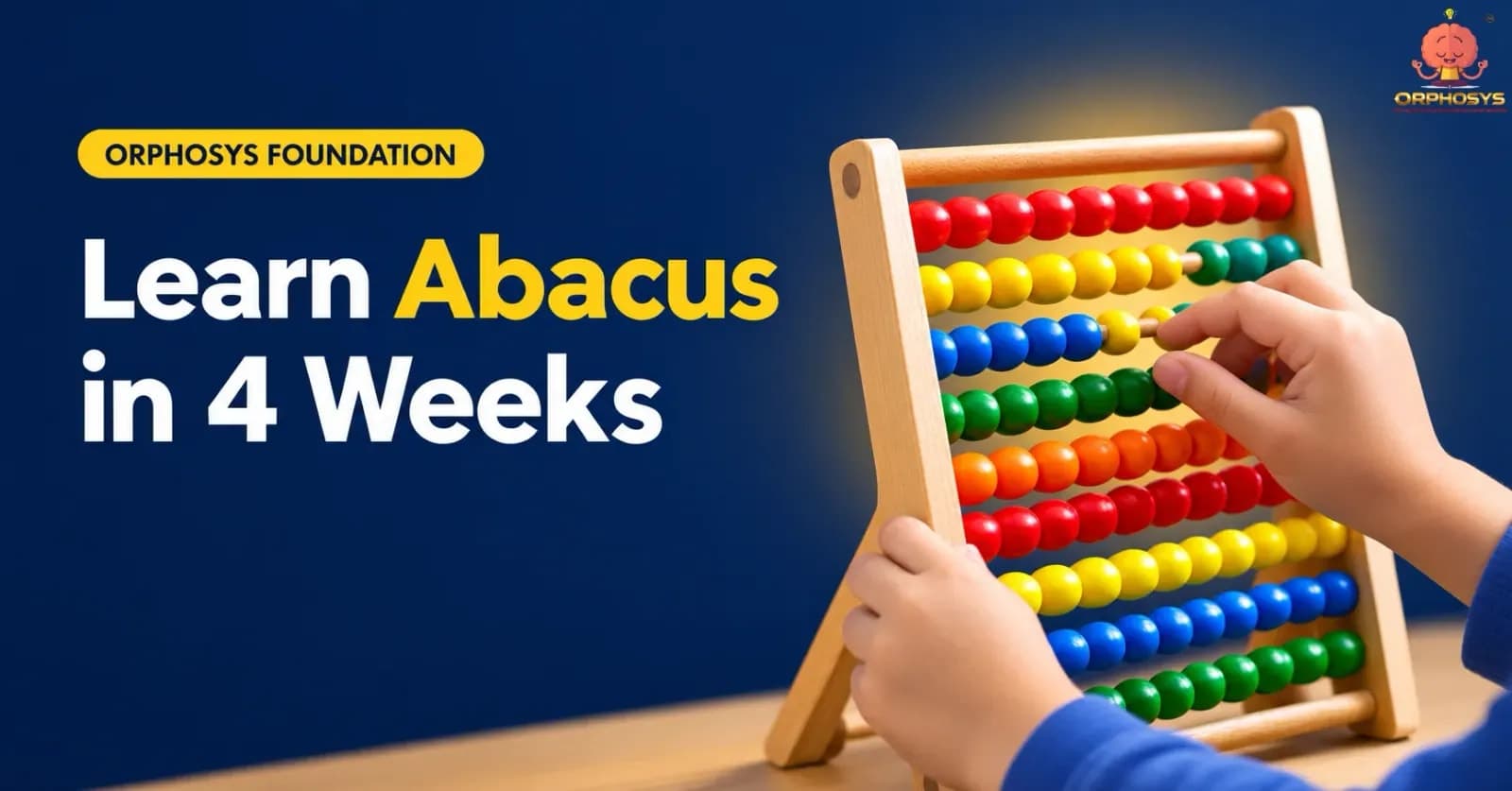
How to Learn Abacus Calculations: A Beginner's Guide for Parents
By Orphosys Foundation | 06.10.2026 | 8 min read
If you are a parent wondering how to learn abacus calculations, or how to help your child learn them, you are in the right place. The abacus looks like a simple frame of beads, but used well it trains focus, memory and number sense. It also confuses many parents at first.
This guide explains how the abacus works, how children learn to calculate on it, a simple 4-week plan you can follow at home, and how to choose a good abacus class without surprises.
What Is an Abacus and Why Do Children Learn It?
An abacus is a counting tool with rows of beads on rods. Each rod stands for a place value: ones, tens, hundreds and so on. Children move the beads with their fingers to add, subtract, multiply and divide.
Over time, good learners stop looking at the abacus and picture it in their mind. This is called mental abacus, and it is why abacus training is linked with concentration, listening and memory. Many parents also notice more confidence with numbers.
How an Abacus Works: The Basics
Most children's abacuses (called a soroban) have a middle bar that divides each rod.
Each bead below the bar is worth 1 (the "earth" beads).
Each bead above the bar is worth 5 (the "heaven" bead).
Beads only count when they are pushed toward the middle bar.
Each rod is one place value. The rod on the far right is the ones place, and the next rod to the left is the tens place.
Example: to show 7, push the upper bead down (5) and two lower beads up (2 more).
How to Learn Abacus Calculations: Step by Step
Step 1: Get Comfortable With the Tool
Show your child the parts. Practice clearing the abacus and setting numbers from 1 to 9 on one rod, using the thumb and index finger only.
Step 2: Practice Simple Addition and Subtraction
Start with sums that fit directly on the beads, such as 2 + 3 or 4 - 1. Do this daily until the finger movements feel automatic.
Step 3: Learn the "Small Friends" (Making 5)
When there are not enough earth beads, use the heaven bead.
Example: 3 + 4. You cannot add 4 beads, so add 5 and take away 1. 3 + 5 - 1 = 7.
Step 4: Learn the "Big Friends" (Making 10)
When a sum crosses 10, carry to the next rod.
Example: 8 + 7. Add 10 on the tens rod and take away 3. 8 + 10 - 3 = 15.
Step 5: Move to Multi-Digit Numbers
Work rod by rod, from the left, carefully and slowly. Accuracy first, speed later.
Step 6: Start Visualizing
When your child is confident, ask them to close their eyes, picture the abacus, and move their fingers in the air as if using it. This builds mental abacus.
A Simple 4-Week Practice Plan for Parents
Practice for about 10 to 15 minutes a day. Short and regular beats long and rare.
Week 1: Parts of the abacus, setting and clearing numbers 1 to 9
Week 2: Addition and subtraction without friends (direct moves)
Week 3: Small friends (making 5), with oral practice
Week 4: Big friends (making 10), then a few minutes of visualization
Every few days, stop and let your child explain what they are doing. If they can explain it, they understand it.
Common Mistakes Parents Make (and How to Avoid Them)
Pushing for speed too early. Accuracy comes first. Speed follows on its own.
Comparing with other children. Every child moves at their own pace.
Skipping the basics. Weak finger technique shows up later as mistakes.
Practicing only before exams or competitions. Daily habit matters most.
Treating abacus as separate from school math. Ask your child to check school sums with the abacus method, and explain why the answer is right. This keeps the abacus method and the school method working together instead of confusing each other.
What Abacus Can and Cannot Do
Honest expectations matter, so here they are.
Abacus can build calculation speed, focus, listening and confidence with numbers.
Abacus does not replace understanding concepts such as algebra or geometry. Your child still needs strong school math.
Results depend on regular practice and a good teacher. No program can guarantee the same result for every child, so be careful with exaggerated promises.
Learning at Home or in a Class?
Home practice is great for building the habit. A trained teacher helps most with correct technique, structured levels and keeping your child motivated. Many families use both: a class plus short daily practice at home.
How to Choose a Good Abacus Class: 7 Questions to Ask
Before you pay any fee, ask these questions.
1. Is the teacher trained and certified?
Ask how they were trained, and sit in on a trial class.
2. What is the full cost?
Get fees for every level, books, materials, exams and competitions in writing.
3. How do certificates and level exams work?
Know the process before enrolling.
4. How will I see my child's progress?
Ask for regular level-wise reports, not only exam results.
5. How long is each class?
Young children need short, lively sessions with breaks.
6. How does the program connect with school math?
Good centers explain the link and welcome questions.
7. How do the teachers treat children and parents?
Watch a class. Patience and respect are essential.
If a center cannot answer these clearly, keep looking.
How Orphosys Foundation Teaches Abacus
At Orphosys Foundation, we teach abacus as part of a wider approach to child brain development, alongside Vedic math, DMIT and spoken English. Our learners also get interactive practice through the Orphosys Kids app with Beady,
Not sure if abacus is right for your child? Ask for a trial class and see for yourself.

Frequently Asked Questions (FAQ)
At what age can a child start learning abacus?
Most programs start around ages 5 to 6 and continue to about 12 to 14. Younger children can begin with simple bead play, and the right starting point depends on the child. Contact your nearest Orphosys center to find the right level.
How long does it take to learn abacus calculations?
Most children understand the basic moves within 3 to 4 weeks of regular practice. Moving to fast mental calculation takes many months across several levels. Daily practice makes the biggest difference.
Can I teach my child abacus at home?
Yes, for the basics. A simple abacus, 10 to 15 minutes a day and the plan above will get you started. A trained teacher is helpful for correct technique and for moving up the levels.
Does abacus really improve math and focus?
Many children become faster and more confident with numbers, and the concentration it builds can help in other subjects. It does not replace learning school math concepts, and results vary from child to child.
Will abacus confuse my child's school math?
It does not have to. Encourage your child to explain their answers and to use abacus to check school sums. If your child seems confused, tell the teacher early.
How much do abacus classes cost?
Fees vary by center and city. Always ask for the full cost, including levels, books, exams and competitions, before you enrol.
What is the difference between abacus and mental abacus?
Abacus means calculating with the physical beads. Mental abacus means picturing the abacus in your mind and calculating without it.
Is online abacus learning as good as a class?
Online lessons can work well if the teacher watches the child's finger technique and gives feedback. Children who need extra motivation often do better in person.
How can I find a good abacus class near me?
Use the 7 questions in this guide. Visit, watch a trial class and compare. You can also contact Orphosys Foundation to find a center near you.
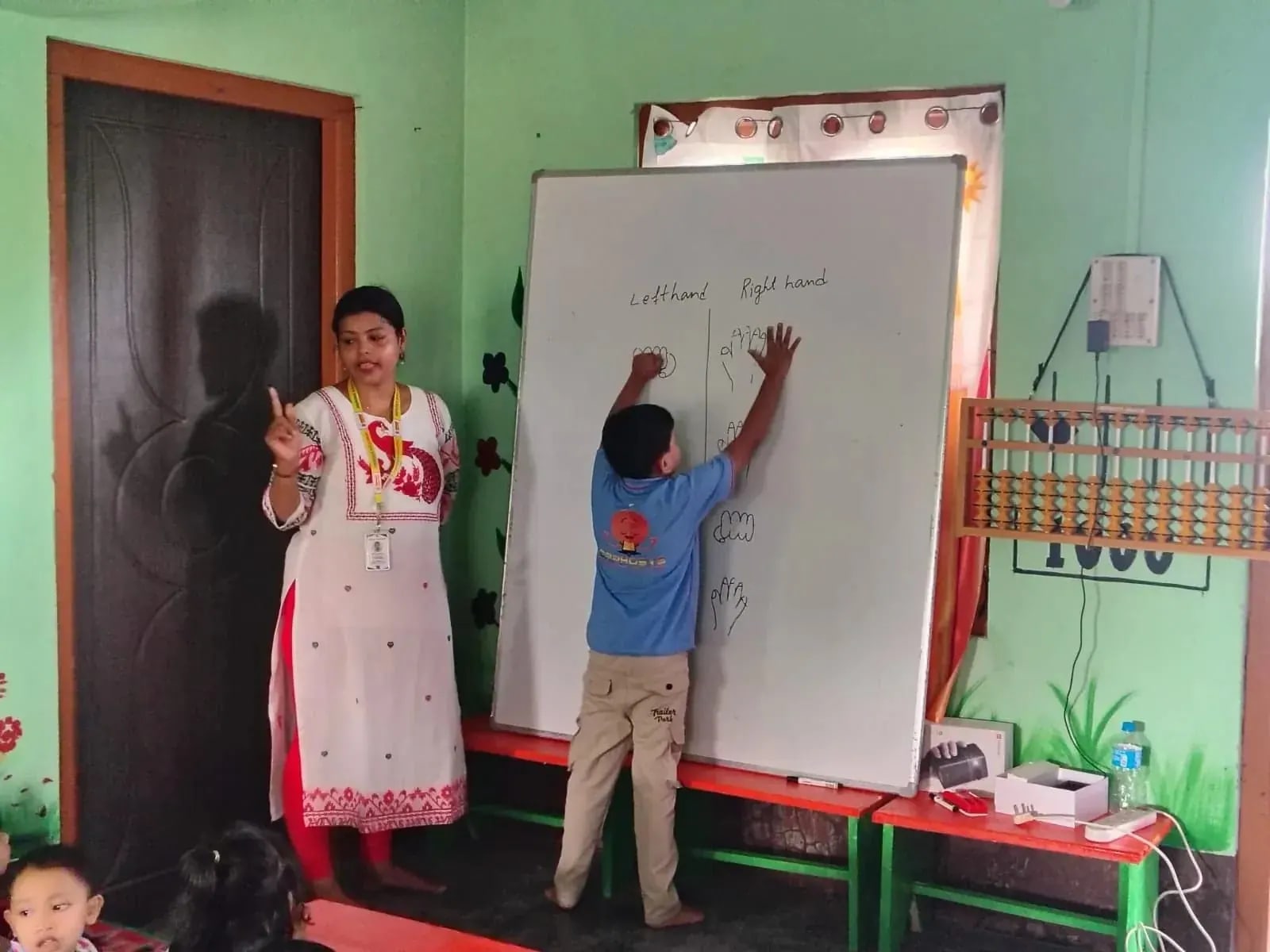
Look at this young learner writing with both hands at once! At Orphosys Foundation, we train children to use both sides of the brain, building focus, coordination and confidence.

Related reading: 5 Proven Ways Abacus Training Transforms Your Child's Brain Power
Start Your Child's Abacus Journey
Abacus works best with patience, daily practice and a teacher who makes learning fun. If you would like a trial class or a free guidance session for your child, contact Orphosys Foundation and we will help you find the right start.
Orphosys Team
Editorial team at Orphosys Foundation, dedicated to brain development and academic excellence.
Discussion (0)
Be the first to share an insight