
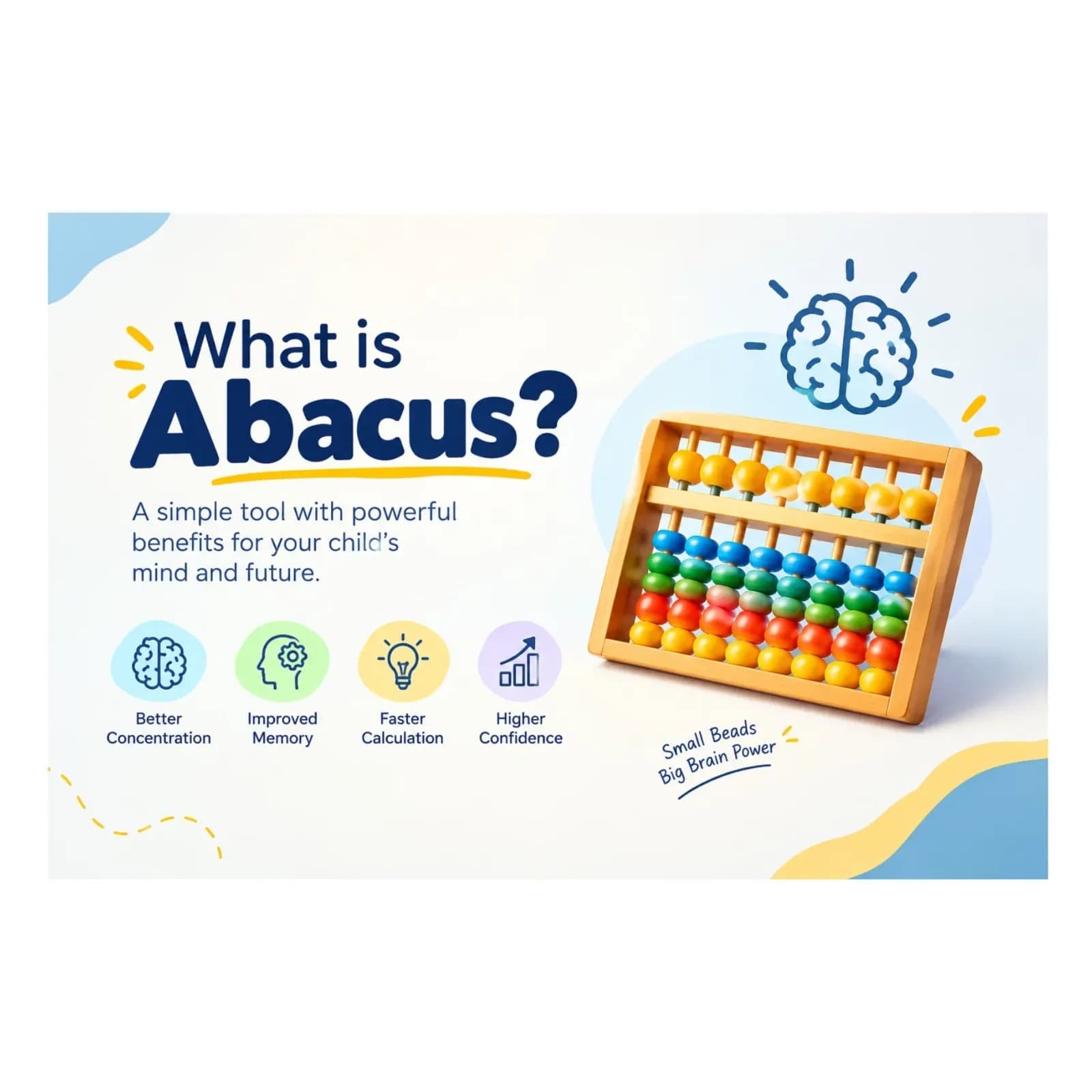
What Is Abacus? | Complete Guide to History, Types & Benefits
Quick answer: An abacus is a manual calculating tool made of a frame holding rods strung with movable beads, where each bead's position represents a number. Users slide beads to perform addition, subtraction, multiplication, and division by hand. Though invented thousands of years ago, the abacus is still widely used today as an educational tool that builds children's mental math skills, focus, and number sense. read more
If you've ever watched someone's fingers fly across a frame of beads and produce an instant calculation, you've seen an abacus in action. Long before calculators and smartphones, this simple counting tool was the world's go-to device for arithmetic — and remarkably, it's still used today, both as a practical tool in parts of the world and as a powerful learning aid for children.
So, what is abacus exactly, how does it work, and why does it still matter in a world full of digital calculators? Let's break it down.
What Is Abacus?
An abacus is a manual calculating tool consisting of a frame that holds a series of rods or wires, each strung with movable beads. Every bead represents a specific value depending on its position on the rod, and every rod represents a place value — ones, tens, hundreds, thousands, and so on. By sliding beads toward or away from a central bar, a user can represent numbers and carry out arithmetic operations such as addition, subtraction, multiplication, and division.
Unlike an electronic calculator, an abacus doesn't compute anything on its own. It's the person operating it who does the mental work, using the beads as a visual and physical aid to track the calculation. This is exactly why the abacus has become so popular in children's education: it turns abstract number concepts into something a child can literally see and touch.
Historians don't agree on exactly where or when the abacus was invented — theories point to ancient Mesopotamia, China, Greece, and Rome as possible origins, with early counting boards dating back thousands of years. What's clear is that variations of the abacus developed independently in several civilizations, each adapting the basic bead-and-rod concept to its own number system.
How Does an Abacus Work?
Every abacus organizes beads into columns, with each column standing for a place value. On most designs, beads are split into an upper and lower section:
Lower beads typically represent units of 1.
Upper beads typically represent a value of 5.
To "enter" a number, you push the lower beads toward the center bar and pull the upper beads toward it as well. To read a number off the abacus, you add up the values of all the beads moved toward the center in each column, then combine the place values from right to left.
For example, on a standard column with five lower beads (each worth 1) and one or two upper beads (each worth 5), pushing three lower beads up gives you 3. Pulling one upper bead down and pushing two lower beads up gives you 5 + 2 = 7. Addition and subtraction are done by physically moving beads to add or remove value, carrying over to the next column when a place value is "full" — similar to carrying a digit in written arithmetic. With practice, users can perform multiplication, division, and even square roots.
Main Types of Abacus Around the World
While the basic bead-and-rod principle is universal, different cultures developed their own versions, each with a distinct design:
1. Chinese Abacus (Suanpan) One of the most recognized forms, the suanpan typically has two beads above the divider and five below, allowing it to handle both decimal and some hexadecimal calculations. It performs addition, subtraction, multiplication, division, and even root calculations.
2. Japanese Abacus (Soroban) Developed from the Chinese suanpan around the 14th century, the soroban simplified the design to one bead above the divider and four below, making calculations more streamlined. It's still taught in some Japanese schools today, largely for its cognitive benefits rather than practical necessity.
3. Russian Abacus (Schoty) Distinct in orientation, the Russian abacus arranges its rods horizontally rather than vertically, with beads slid from side to side instead of up and down.
4. Roman Abacus One of the earliest known forms, used by merchants and engineers in the ancient world. Early versions were simple counting boards with loose stones or pebbles, while later hand-held versions used grooved metal plates with sliding counters.
5. Cranmer Abacus Designed by Tim Cranmer specifically for use by people who are blind or visually impaired, this version uses a firm backing and snug-fitting beads so users can perform calculations by touch alone.
6. Binary Abacus A modern teaching tool used to explain how computers represent numbers, with beads standing for "on" and "off" states (1s and 0s) rather than decimal digits.
Why the Abacus Still Matters Today
It's easy to assume the abacus became obsolete the moment calculators arrived, but its role has simply shifted — from a practical computing device to an educational one.
It builds strong mental math skills. Regular abacus practice trains the brain to visualize a bead frame and "see" numbers being manipulated even without a physical abacus in hand — a technique known as mental abacus, which allows experienced users to perform surprisingly fast calculations in their heads.
It supports cognitive development in children. Because abacus work demands sustained focus, hand-eye coordination, and active visualization, it's often linked to improvements in concentration, working memory, and problem-solving ability in young learners. read more
It makes math tangible. For children who find abstract numbers intimidating, physically moving beads to represent a calculation can make math feel less like a wall of symbols and more like a hands-on puzzle — which can reduce math anxiety over time.
It's an accessible tool for visually impaired learners. Tactile versions like the Cranmer abacus give people who are blind or low-vision a genuine way to perform and check calculations independently.
It can improve fine motor skills. The repetitive, precise finger movements involved in sliding beads are sometimes credited with helping children develop better hand-eye coordination, which can carry over into neater, faster handwriting.
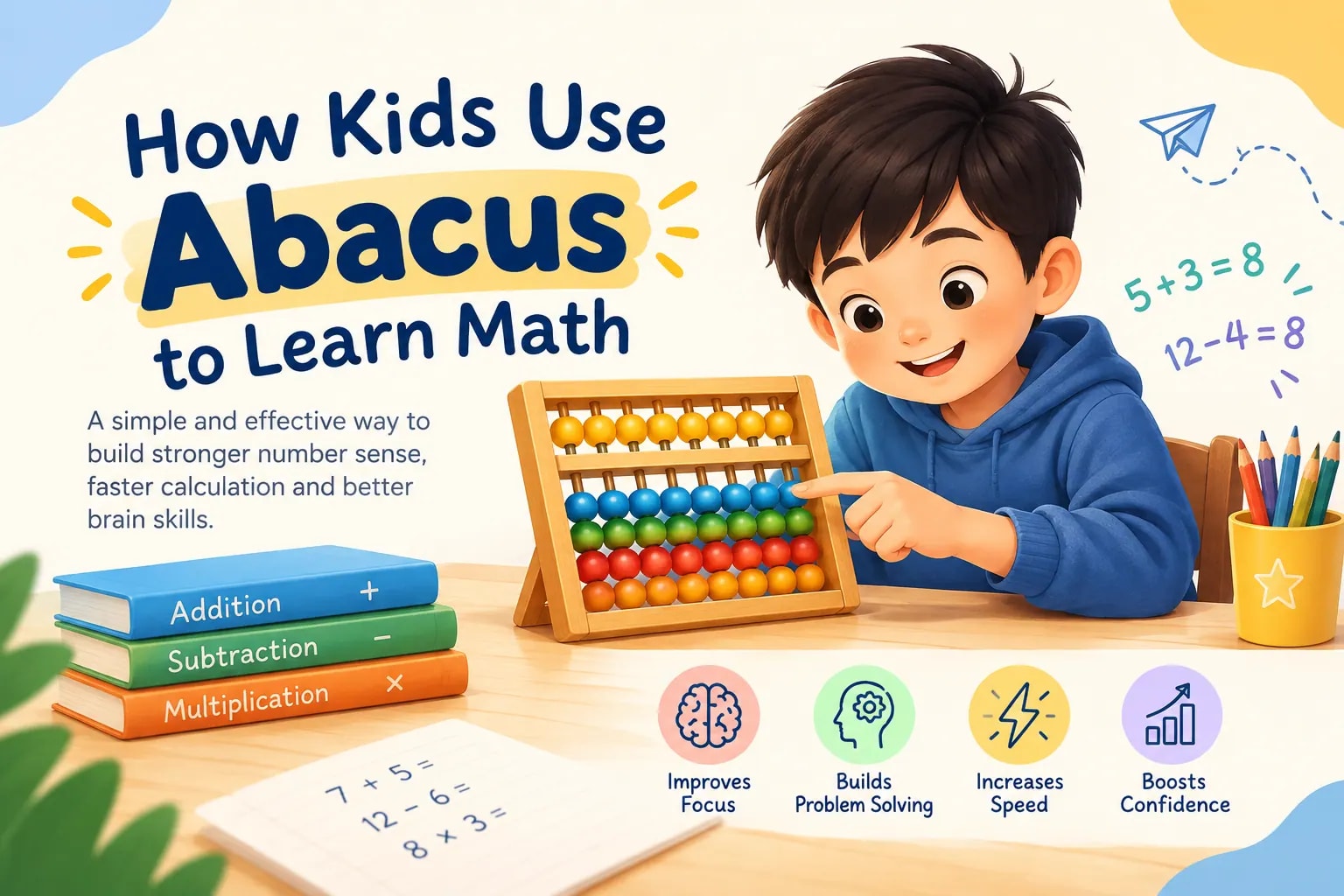
How Kids Use Abacus to Learn Math
Many abacus-based learning programs, including Orphosys Foundation's, introduce the tool to children as young as five or six. At this stage, kids typically start with simple number representation — learning to show a number like 23 on the beads — before progressing to addition and subtraction, and eventually more advanced multi-digit operations and mental abacus visualization.
The appeal for parents and educators is that abacus training doesn't just teach a calculation shortcut; it's often framed as a way to build a foundation of numeracy, confidence, and focus that supports a child's broader academic performance — not just their math scores.
Frequently Asked Questions
What is abacus used for? An abacus is used to perform arithmetic — addition, subtraction, multiplication, division, and even square or cube roots — by moving beads along rods to represent numbers. It's also widely used today as an educational tool to build mental math skills in children.
Which is the most common type of abacus? The Chinese suanpan and the Japanese soroban are the two most widely recognized types, though the soroban's simpler bead arrangement makes it especially popular in modern abacus-learning programs.
Is the abacus still used today? Yes. While it's no longer a primary calculating tool in most parts of the world, it remains in everyday use in some regions and is widely taught in schools and enrichment programs for its cognitive and educational benefits.
At what age should a child start learning abacus? Most abacus learning programs introduce children to the tool between ages 5 and 8, when they're developing basic number sense and fine motor coordination.
Final Thoughts
The abacus may be one of humanity's oldest tools, but it hasn't outlived its usefulness — it's simply found a new purpose. What began as a practical calculating device for merchants and traders has become a bridge between abstract numbers and hands-on understanding, helping learners of all ages build number sense, focus, and confidence one bead at a time.
Orphosys Foundation teaches Abacus using this same structured, level-based approach — across centers in Kolkata, Ranchi (Jharkhand), Bhubaneswar (Odisha), Assam, and Tripura.
Get in touch: 📞 +91 90462 40290 🌐 orphosysfoundation.org
Related reading: Abacus Classes for Kids: Benefits, Age to Start & What to Expect | Abacus Classes Near Me: Why Orphosys Foundation Is the Right Choice
Orphosys Team
Editorial team at Orphosys Foundation, dedicated to brain development and academic excellence.
Discussion (0)
Be the first to share an insight