
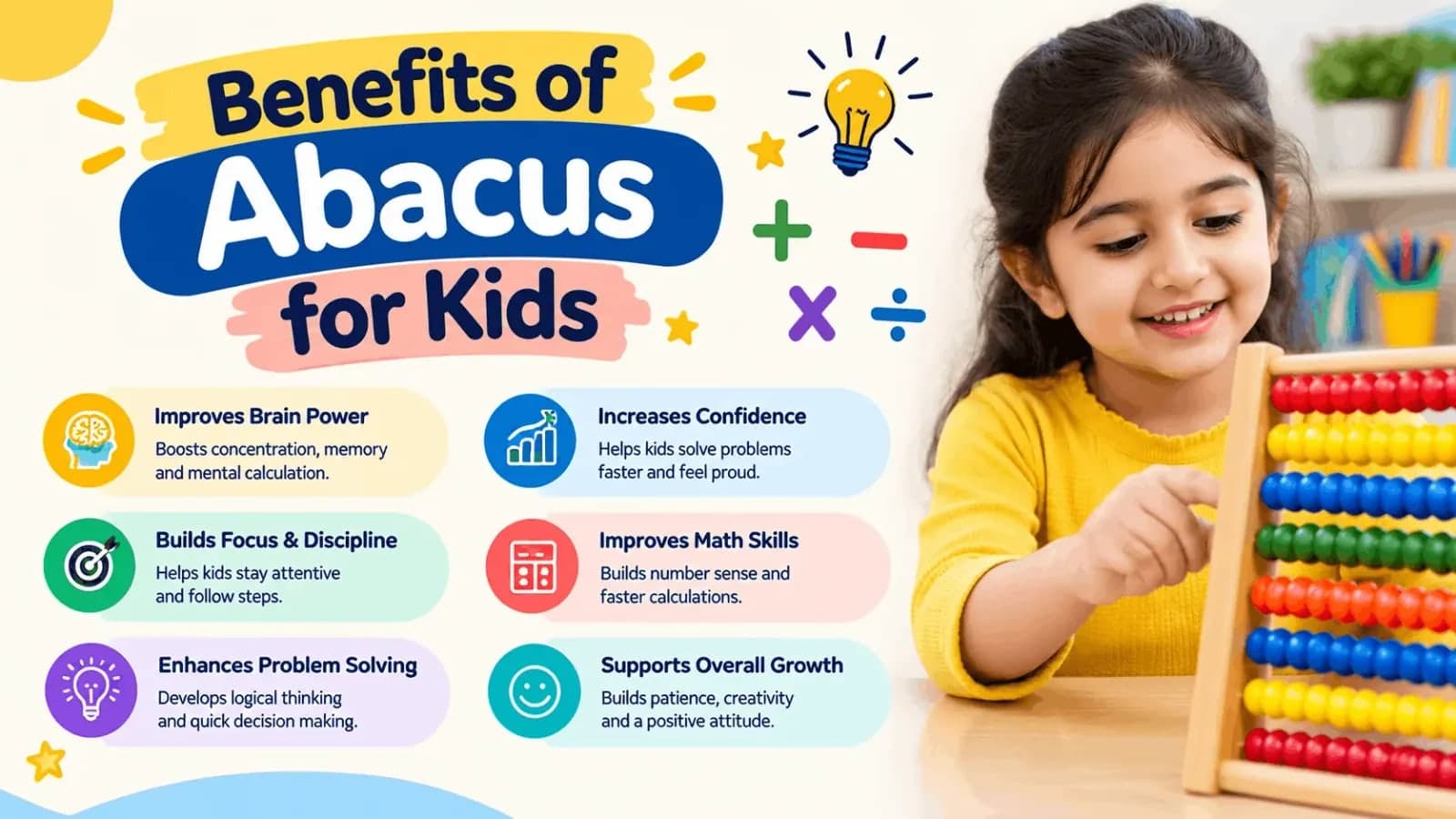
Benefits of Abacus for Kids: What Our Classroom Experience and the Research Actually Show
Since we opened Orphosys Foundation in 2019, I have worked with children and their parents. The same worries come up in almost every first meeting. "My child is scared of maths." "He cannot sit and focus." "Will this really help, or is it just a trick?"
This blog answers those worries one by one. For each problem I explain what I have seen in the classroom and what the research says. Where the research is weaker than the marketing, I say so.
What Is Abacus Learning, in Simple Words?
Children first learn to move beads on a physical abacus to add, subtract, multiply and divide. After some months, they start to picture the abacus in their mind and move the beads in their imagination. This is called mental abacus.
So an abacus class is really training in visual thinking, not memorising tables.
Problem 1: "My child is afraid of maths"
The problem: Many children decide by age 7 or 8 that they are "bad at maths." Numbers on paper feel abstract, and one wrong answer in front of the class can put a child off for years.
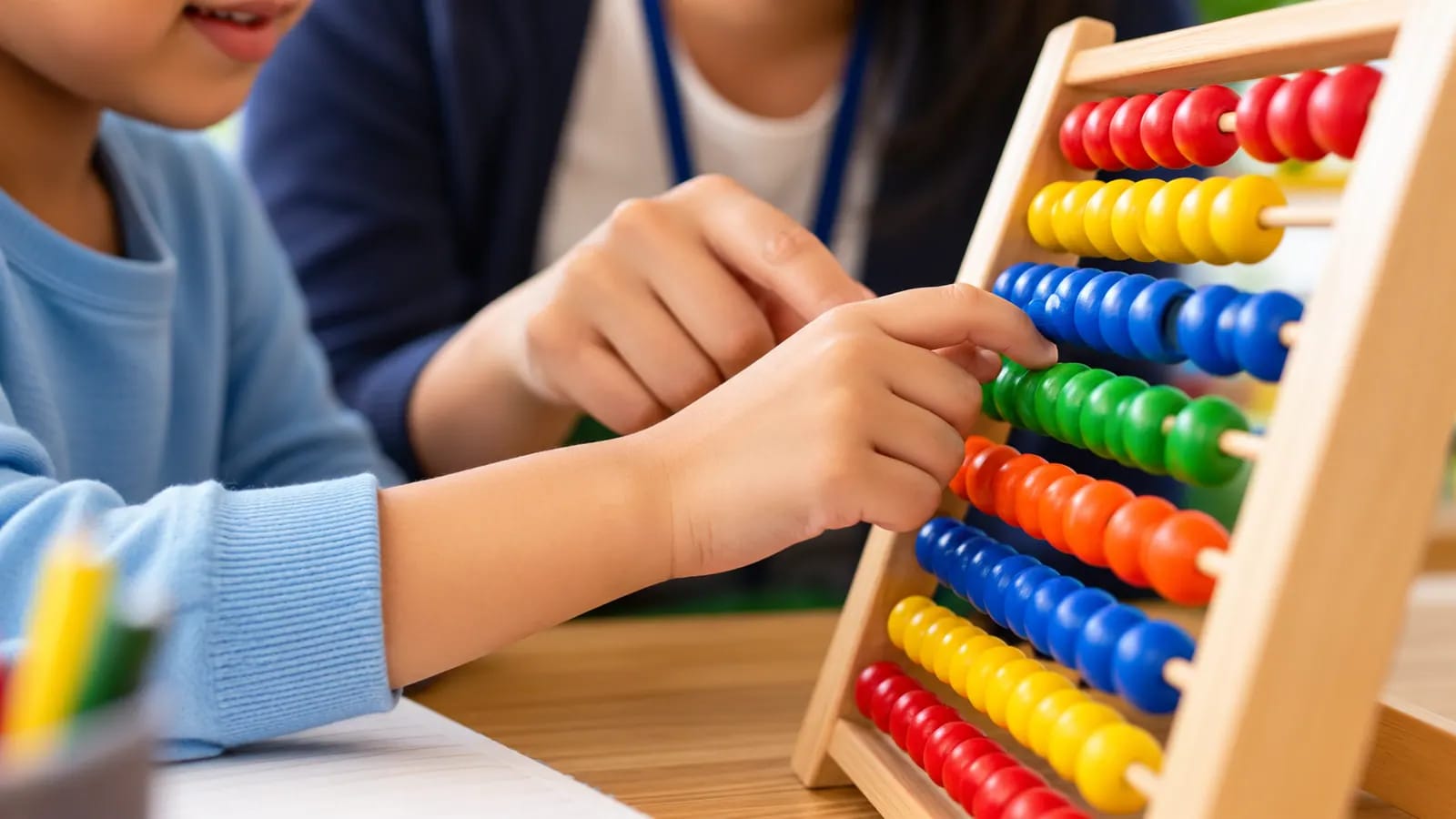
The solution: The abacus makes numbers something a child can touch and see. A child who sees that 7 is five beads plus two beads is not guessing. In my experience, the fear drops once children get answers right on their own.
The research supports this. A three-year randomised trial followed 204 children who were 5 to 7 years old at the start, and the abacus group did better than the control group on arithmetic tasks. The children learned in ordinary classrooms, not in special labs.
Problem 2: "My child cannot focus for more than a few minutes"
The problem: Parents tell me their child jumps from one thing to another, forgets instructions and loses track in the middle of homework.
The solution: Abacus calculation cannot be done while distracted. A child has to listen, hold a number in mind, move the beads and check the answer. That is a daily workout for attention and self-control.
Researchers have looked at this too. A brain imaging study of Chinese children found that long-term abacus-based mental calculation training may improve executive function, the set of skills behind self-controlled behaviour, and make the front and side brain regions work more efficiently.
I want to be careful here. The word is "may." Studies like this show a link, and they do not promise a result for every child.
Problem 3: "Is this just fast calculation, or will it help in school?"
The problem: Parents worry they are paying for a party trick. They want to know whether it will show up in school marks.
The solution: The honest answer has two parts.
First, abacus clearly builds strong arithmetic and number sense, and that supports school maths. Second, it is not a magic switch for general intelligence. One randomised study that compared abacus training with other cognitive training and with English lessons found no broad transfer to general abilities that do not involve numbers or visual-spatial thinking.
I would rather tell you this than oversell. Abacus is excellent at what it is built for. It works best alongside reading, play, sleep and good teaching, never as a replacement for them.
Problem 4: "Will my child be able to keep up?"
The problem: Parents see other children racing ahead and worry that their own child is "not abacus material."
The solution: Children do learn at different speeds, and the research agrees. The same India-based trial found that children who began with weaker spatial and working memory did not get the same large benefit. Other work suggests a child's starting spatial working memory shaped how well they learned the technique.
In practice, this means a child who struggles needs a slower pace, more hands-on practice and a teacher who watches each child. They do not need to be pulled out of the class. Since 2019, the children who improved most were usually the ones who practised a little every day, not the ones who started fastest.
Not sure if your child is ready? Come and watch a class first. Book a demo class at Orphosys Foundation and see how your child responds before you decide. Book a Demo Class
Problem 5: "My child is on screens all day. What is a hands-on alternative?"
The problem: Between phones, tablets and TV, many children have little screen-free skill-building time.
The solution: The abacus is a physical tool. Fingers move beads, eyes follow, ears listen to the questions. This is a hands-on habit that fits in 15 to 20 minutes a day. There is little formal research on the screen-time benefit specifically, so I offer this as classroom experience and not as a proven claim.
What the Research Does and Does Not Say
Abacus training helps children get better at arithmetic. This is the strongest finding.
Some studies link it to better working memory. In one study of 64 children, those with five years of abacus training were faster and more accurate on a memory task than their peers.
Evidence for improved focus and brain efficiency exists but is still developing.
Evidence that abacus raises general intelligence is limited.
Frequently Asked Questions
What is the best age to start abacus classes?
Most programmes start around age 5 to 6, when children can hold a pencil and follow simple counting. The trial above began with children aged 5 to 7. Every child is different, so a short trial class is the best test.
How long before I see results?
Parents usually notice more confidence in simple sums within the first few months. Mental abacus takes longer, because it needs steady practice over several levels.
Do children still need to learn school maths?
Yes. Abacus supports school maths, it does not replace it.
How much daily practice is needed?
In my experience, 15 to 20 minutes a day beats a long session once a week.
Is abacus good for every child?
Most children enjoy and benefit from it, but progress differs. Good teaching adapts to the child.
My Final Advice to Parents
The benefits of abacus for kids are real: stronger arithmetic, more confidence and better concentration habits. The size of the benefit depends on how consistently the child practises and how well the teacher knows the child.
If you would like to see how it works, bring your child to a demo class at Orphosys Foundation. Watch how your child responds before you decide.
Where Your Child Can Start at Orphosys
Every child is different, so choose the starting point that fits yours:
Orphosys Abacus: mental arithmetic and brain development programs for children aged 4 to 15, with trained mentors who give each child personal attention. Book a Demo Class orphosysfoundation.org
Vedic Math Essentials: a practical program for faster calculation, sharper concentration and more confidence in maths. Explore Vedic Math (orphosysfoundation.org/courses)
Brain Mapping and Potential Discovery (DMIT): helps parents understand how their child learns best. Know More About DMIT (orphosysfoundation.org/courses)
Spoken English: builds speaking confidence, and you can also practise through the Orphosys Kids mobile app, which covers abacus, Vedic math and spoken English. Explore Spoken English (orphosysfoundation.org/courses)
Orphosys Foundation is a Kolkata-based child brain development institute. Interested in opening a centre? Enquire About Franchise (orphosysfoundation.org)
References
Barner, D., Alvarez, G., Sullivan, J., Brooks, N., Srinivasan, M., & Frank, M. C. (2016). Learning mathematics in a visuospatial format: A randomized, controlled trial of mental abacus instruction. Child Development, 87(4), 1146-1158. https://doi.org/10.1111/cdev.12515
Effect of abacus training on executive function development and underlying neural correlates in Chinese children. Human Brain Mapping, 38(10), 5234-5249 (2017). https://pmc.ncbi.nlm.nih.gov/articles/PMC6867117
Study comparing abacus, cognitive and English training for transfer effects. Current Psychology (2021). https://link.springer.com/10.1007/s12144-021-01968-1
British Psychological Society Research Digest (2016). Summary of the Barner et al. trial. https://bps.org.uk/research-digest/teaching-children-ancient-mental-abacus-technique-boosted-their-maths-abilities
Abacus training and working memory in children (conference abstract, ISMRM 2017). https://cds.ismrm.org/protected/17MProceedings/PDFfiles/5357.html
Orphosys Team
Editorial team at Orphosys Foundation, dedicated to brain development and academic excellence.
Discussion (0)
Be the first to share an insight