
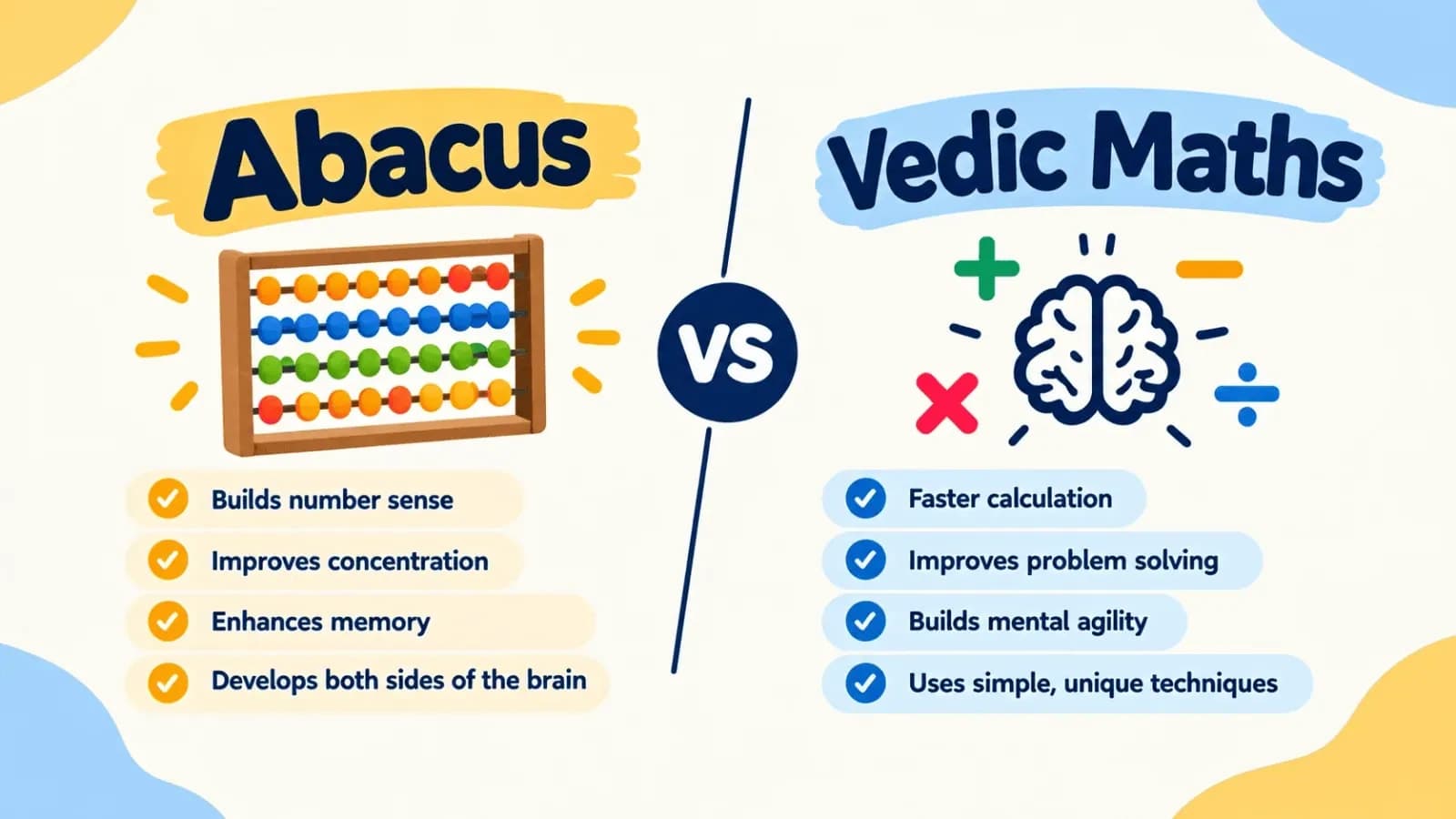
Abacus vs. Vedic Maths: What We've Learned After 13+ Years of Teaching Both
I'll be honest with you — this is probably the question we get asked the most at Orphosys Foundation. A parent walks in, sits down, and within the first two minutes asks: "Abacus or Vedic Maths — which one should my child do?"
We've been running Abacus and Vedic Maths programs since 2012, and in that time we've taught this to thousands of children across our centers. So this isn't a textbook answer — it's what we've actually seen work, and not work, in real classrooms with real kids.
The Difference, In Plain Terms
Here's how I explain it to parents on day one:
Abacus trains a child to solve calculations by picturing a bead-frame in their head. At first they use the physical tool, but within a few months, the tool disappears — they're just moving imaginary beads and getting the right answer, fast. It's less about "maths" and more about training the brain to focus, visualize, and hold information — the arithmetic is just the vehicle.
Vedic Maths is different. It's a collection of clever shortcuts — techniques for multiplying, squaring, and simplifying big calculations in a few steps instead of ten. It doesn't build a new mental skill the way Abacus does; it sharpens a skill that's already there.
I always tell parents: Abacus builds the engine. Vedic Maths tunes it for speed.
Abacus Vedic Maths Core method Mental visualization of a bead frame Pattern-based shortcut techniques Best age to start 5–8 years 10+ years Strongest for Basic arithmetic, concentration, memory Multiplication, algebra, exam speed Skill built Whole-brain coordination, focus Logical shortcuts Best used for Early foundation Exam-ready speed
Why We Recommend Sequencing, Not Choosing
In our early years, we made the mistake of letting parents pick either program independently, based on preference. What we noticed over time was telling: children who jumped straight into Vedic Maths without an Abacus foundation could perform the tricks, but they didn't really understand numbers. The moment a problem didn't fit the pattern they'd memorized, they froze.
Children who came through Abacus first, then moved to Vedic Maths, were different. They weren't just fast — they understood why the shortcut worked, which meant they could adapt when a question was phrased differently or asked in an unfamiliar way.
That single observation changed how we structure our curriculum. Today, we don't sell Abacus and Vedic Maths as competing products. We treat them as two stages of the same journey.

The Proof — Not Just Our Word for It
We didn't want to just rely on what we've seen in our own centers, so it's worth looking at the wider research too:
A study on 121 primary-school children found that Mental Abacus training led to statistically significant improvements in cognitive flexibility compared to children who received standard arithmetic instruction — suggesting the benefits go well beyond just calculation speed.
Brain-imaging research on abacus experts (Tanaka et al., 2002, Neuropsychologia) found increased grey matter density in regions of the brain tied to mathematical reasoning and visual-spatial processing.
A more recent 2024 study on 11–13-year-olds found a significant improvement in solving mixed arithmetic operations after abacus training, along with higher motivation reported directly by the students themselves.
This lines up with what our own mentors report every year: the children who start with Abacus don't just get faster at maths — they get calmer during tests, more willing to attempt hard problems, and noticeably more confident overall.
It's also reflected in what our own parents tell us. As one mother, Arunima Roy, put it: "Orphosys has completely changed the way my child thinks and learns." We hear versions of that sentence more often than almost anything else.
My Honest Recommendation
If your child is under 8 — start with Abacus. Don't rush to shortcuts before the foundation is solid.
If your child is 10+ and already comfortable with basic arithmetic — Vedic Maths will give them a real, noticeable edge, especially heading into competitive exams.
If you're unsure — that's completely normal, and it's exactly why we don't recommend guessing. We assess every child individually before suggesting a starting point, because what worked for one 7-year-old isn't automatically right for another.
Frequently Asked Questions
1. What is the main difference between Abacus and Vedic Maths? Abacus builds mental calculation through visualization of a bead frame. Vedic Maths teaches logic-based shortcuts for faster computation. One builds the foundation; the other builds speed on top of it.
2. What is the right age to start Abacus or Vedic Maths? We generally recommend Abacus between ages 5–8, and Vedic Maths from age 10 onward, once basic number sense is already in place.
3. Can my child learn both together? We don't recommend it. In our experience, children benefit far more from completing Abacus first and then layering Vedic Maths on top, rather than learning both simultaneously.
4. Does Abacus actually help with school exams, or is it separate from schoolwork? Both. Research and our own classroom experience consistently show improvements in concentration, memory, and confidence — all of which carry directly into exam performance.
5. My child is anxious about maths. Will this help? In our experience, yes — significantly. Abacus in particular builds confidence through small, consistent wins, which helps ease maths anxiety over time rather than adding more pressure.
6. How do I know a program is genuinely effective and not just marketing? Ask whether the center assesses your child individually, or pushes everyone through the same fixed track. We always start with a counseling conversation before recommending anything.
7. How long before we see results? Most parents notice a difference in speed and focus within a few months. Full mastery — especially of Vedic Maths techniques — usually builds over 1–2 years of consistent practice.
Ready to Give Your Child the Right Foundation?
You don't have to figure this out alone, and you don't have to guess between programs. Book a free counseling session with our team, and we'll assess your child's current level and recommend the right starting point — Abacus, Vedic Maths, or both, in the right order.
Read more about What Is Abacus? | Complete History
Orphosys Team
Editorial team at Orphosys Foundation, dedicated to brain development and academic excellence.
Discussion (0)
Be the first to share an insight