
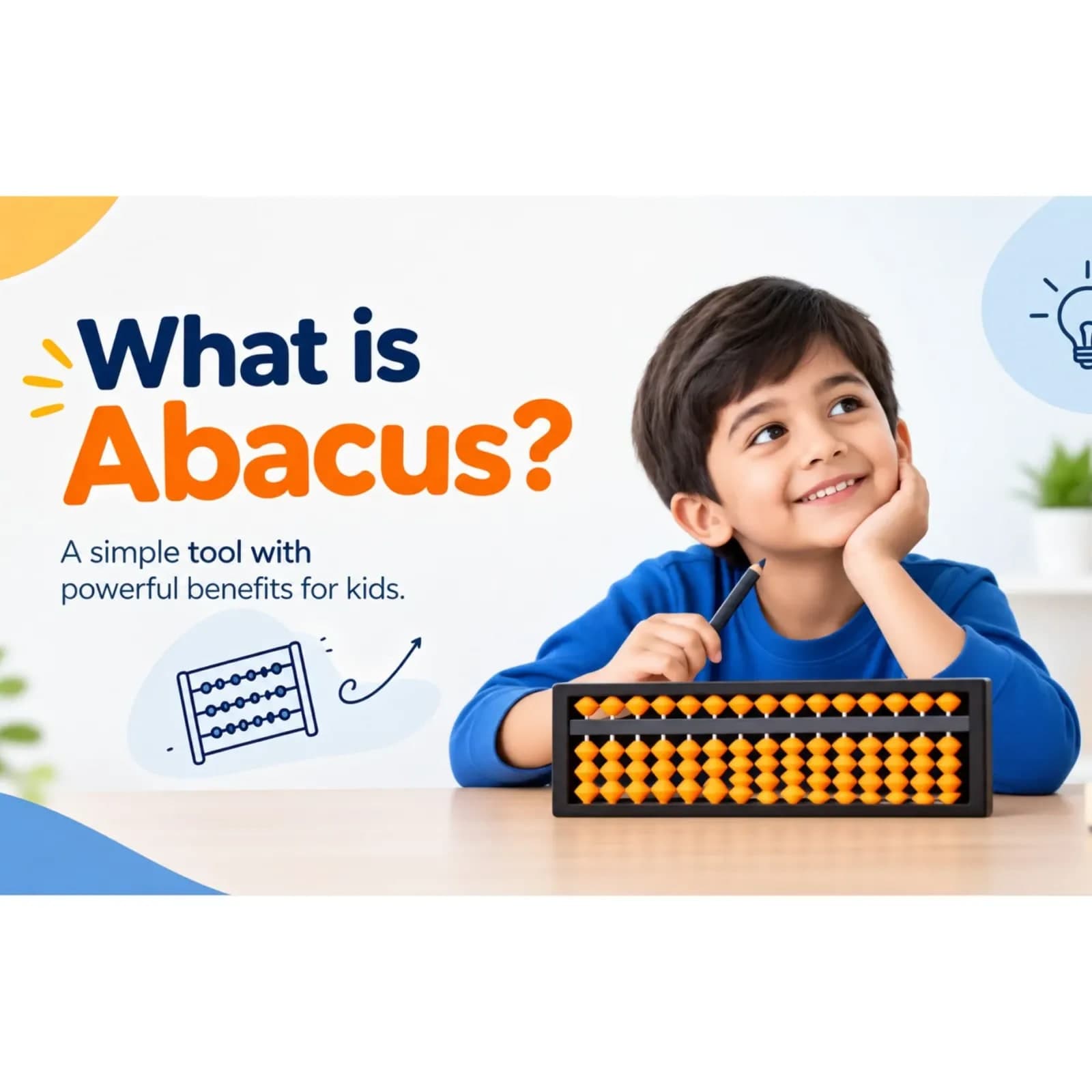
What is Abacus? A Complete Beginner's Guide to the Ancient Calculating Tool
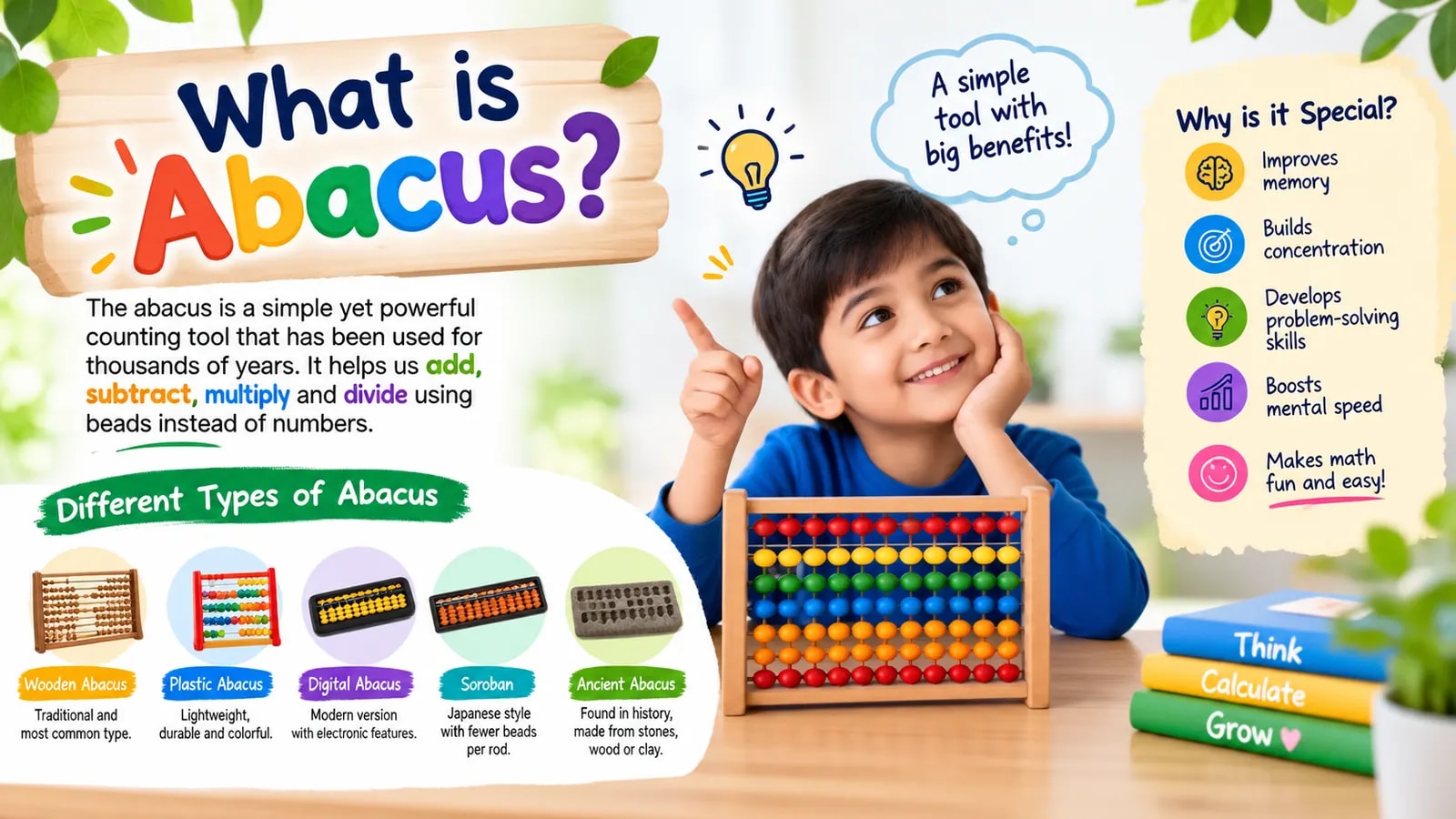
If you've ever wondered, "what is abacus?" — you're not alone. It's one of the most searched questions among parents exploring math enrichment programs for their kids. In simple terms, an abacus is a manual counting tool made of a frame, rods, and beads, used to perform arithmetic calculations like addition, subtraction, multiplication, and division.
But an abacus is far more than an old-fashioned calculator. Today, it's the foundation of a global brain-training method that helps children build faster mental math skills, sharper concentration, and stronger visual memory.
Let's break down exactly what an abacus is, where it came from, and why it's still relevant in the digital age.
What is an Abacus? A Simple Definition
An abacus is a hand-operated counting device consisting of a rectangular frame with rows of vertical rods, each holding a set of movable beads. By sliding the beads up, down, left, or right (depending on the design), a user can represent numbers and carry out calculations.
Unlike a calculator, the abacus doesn't do the math for you — the user's hands and brain do the work. That's exactly why it has become such a popular tool in early childhood math education.
The History of the Abacus
The abacus is one of the oldest calculating tools in human history, with roots tracing back thousands of years to ancient civilizations, including Mesopotamia, Egypt, China, and Rome. The Chinese suanpan and the Japanese soroban are among the most well-known versions still used today, especially the soroban, which forms the basis of most modern abacus learning programs for kids.
Even though electronic calculators eventually became mainstream, the abacus never disappeared. Instead, it evolved into a structured educational tool used to train the brain rather than just crunch numbers.
How Does an Abacus Work?
A standard abacus is divided into two sections by a horizontal bar:
Upper section (heaven beads): Each bead represents 5 units.
Lower section (earth beads): Each bead represents 1 unit.
Numbers are formed by moving beads toward the horizontal bar. As a student becomes more comfortable, they learn specific finger movements and formulas for carrying, borrowing, and combining numbers — much like advanced mental shortcuts.
With consistent practice, students eventually reach a stage called mental abacus, where they visualize the beads moving in their mind and solve calculations without touching a physical abacus at all. This is considered the ultimate goal of abacus training.
Why is Abacus Learning So Popular for Kids?
Abacus classes have grown into a full-fledged brain-development program, particularly for children aged 5 and above. Here's why parents and educators value it:
Whole-brain activation: Using both hands to move beads engages both hemispheres of the brain simultaneously.
Stronger number sense: Kids build an intuitive understanding of numbers rather than just memorizing facts.
Improved focus and concentration: Abacus practice requires sustained attention, which carries over into other academic areas.
Faster mental math: Students often learn to calculate large sums mentally, faster than with a calculator.
Better visual and working memory: Visualizing the abacus mentally strengthens memory retention over time. read on medium
Is the Abacus Still Relevant Today?
Absolutely. While we now have calculators and smartphones in our pockets, the abacus isn't really about the calculation itself — it's about the cognitive training that happens along the way. Many early math programs, tutoring centers, and even online platforms have modernized abacus learning into structured courses for children, combining traditional techniques with interactive digital tools.
This is also why abacus learning has successfully moved online in recent years, allowing kids to learn from home with live instructors, digital worksheets, and virtual abacus tools — no physical kit required.
FAQ: Frequently Asked Questions About Abacus
1. What is abacus in simple words? An abacus is a hand-operated counting tool with beads on rods, used to perform calculations like addition, subtraction, multiplication, and division without electricity or batteries.
2. What age should a child start learning abacus? Most programs recommend starting at age 5 or above, once a child can recognize numbers and count comfortably.
3. Is abacus only for math geniuses? No. Any child with basic number recognition can start learning abacus — it's designed for average learners, not just advanced students.
4. Do kids need a physical abacus to start? Not necessarily. Many programs now offer online abacus tools that work just as effectively for beginners, especially in the early stages.
5. How long does it take to see results? Most children show improvement in speed and focus within a few months of consistent practice, though mastering mental abacus is a longer-term skill built over one to two years.
6. Is abacus the same as Vedic Math? No. Abacus uses a physical or visualized bead-counting system, while Vedic Math relies on formula-based mental math tricks. Both improve calculation speed but through different methods. read on quora
7. What is mental abacus? Mental abacus is the advanced stage where a student solves calculations by visualizing the abacus beads in their mind, without touching a physical device.
8. Can abacus learning help with school math? Yes. Many parents report that abacus training improves a child's speed, accuracy, and confidence with school-level arithmetic, since it builds strong foundational number sense.
Final Thoughts
So, what is abacus, really? It's a centuries-old counting tool that has been reborn as one of the most effective brain-training methods for children. By combining hand movement, visualization, and consistent practice, abacus learning helps kids build math confidence that lasts far beyond the classroom.
If you're considering abacus training for your child, look for a structured program with qualified instructors, a clear progress path, and hands-on practice — whether online or offline — to get the most out of this powerful learning method.
Read more about Abacus Meta Skill Based Abacus | Orphosys Foundation
If you Ready to unlock your child's potential? Get in touch with us
Website: https://orphosyseducation.org/
Phone: +91 9046 240 290
Email: [email protected]
Visit Our Centers:
Corporate Office (Kolkata): 25 B/1 Jheel Road, Annapurna Apartment (Ground Floor), VivekNagar, Dhakuria, Kolkata - 700031 (Near Milan Sangha)
Orphosys Team
Editorial team at Orphosys Foundation, dedicated to brain development and academic excellence.
Discussion (0)
Be the first to share an insight