
Handwriting Improvement for Kids at Home: Answers to Every Parent's Biggest Worries
"My child knows the answers but loses marks for untidy writing."
"He holds the pencil so tightly that his hand hurts."
"She hates writing time and cries before homework."
If any of this sounds familiar, you're not alone. Almost every parent faces some version of it. The good news is that handwriting improvement for kids at home doesn't need expensive tools or hours of extra practice. It needs the right steps in the right order.
Here are the most common worries, and what actually helps.
"Why is my child's handwriting so messy?"
Messy handwriting is rarely about laziness. It usually comes down to one or more of these four issues:
Letter formation: letters are started or shaped the wrong way
Size: letters are too big, too small, or inconsistent
Spacing: words run together or float apart
Line alignment: writing drifts up or down the line
What to do: Look at a page of your child's writing and spot which problem shows up most. Then work on only that one for a week. Fixing everything at once overwhelms children.
Did you know? Children who can form letters automatically have more mental energy left for ideas and spelling. That is why early handwriting affects writing quality later.
"My child holds the pencil the wrong way. Should I correct it?"
Yes, gently, and early. A poor grip tires the hand quickly, so your child writes slowly, presses hard, or gives up.
What to do:
Show the correct hold yourself: pencil resting between the thumb and index finger, supported by the middle finger.
Try a shorter pencil or a triangular pencil. Smaller tools are easier for small hands.
Don't nag mid-homework. Practice grip during short, playful sessions instead.
"He gets tired after writing just a few lines. Why?"
Tiredness often means the small hand muscles aren't strong enough yet. Writing needs finger strength and coordination that children build through play, not only through writing.
What to do (5 minutes a day):
Playdough rolling and pinching
Threading beads
Using tweezers or clothes pegs to pick up small objects
Tearing and pasting paper
Finger games such as abacus bead movement
These build the exact muscles handwriting depends on.
Did you know? Research has linked fine motor skills at school entry to later reading and math results. Strong little hands are an early advantage.
"My child rushes and writes carelessly. How do I slow them down?"
Rushing usually comes from wanting to finish, not from not caring.
What to do:
Swap "write fast" for "write it beautifully once."
Set a small goal: "Three neat lines, then a break."
Praise effort and improvement, not perfection.
Ask your child to pick their best letter on the page and circle it.
"She refuses to write. Any way to make it fun?"
A child who avoids writing is often a child who feels bad at it. Take the pressure off first.
What to do:
Write in sand, salt trays, or shaving foam
Use a whiteboard and play tic-tac-toe or Hangman
Let your child write a grocery list, a birthday card, or a small storybook
Use coloured pens for "special" writing
The goal is to make handwriting feel safe, not like a test.
Did you know? Handwriting difficulties are common. One research paper cites estimates that poor handwriting or dysgraphia affects roughly 10 to 30% of school-aged children. Your child is not alone.
"How much practice is enough?"
Short and daily beats long and occasional. Ten focused minutes a day is enough for most children, and it stops fatigue and frustration from building up.
Did you know? Classroom observation research found that children spend between about 37% and 60% of the school day on hand-based fine motor tasks. A few comfortable minutes of practice at home go a long way.
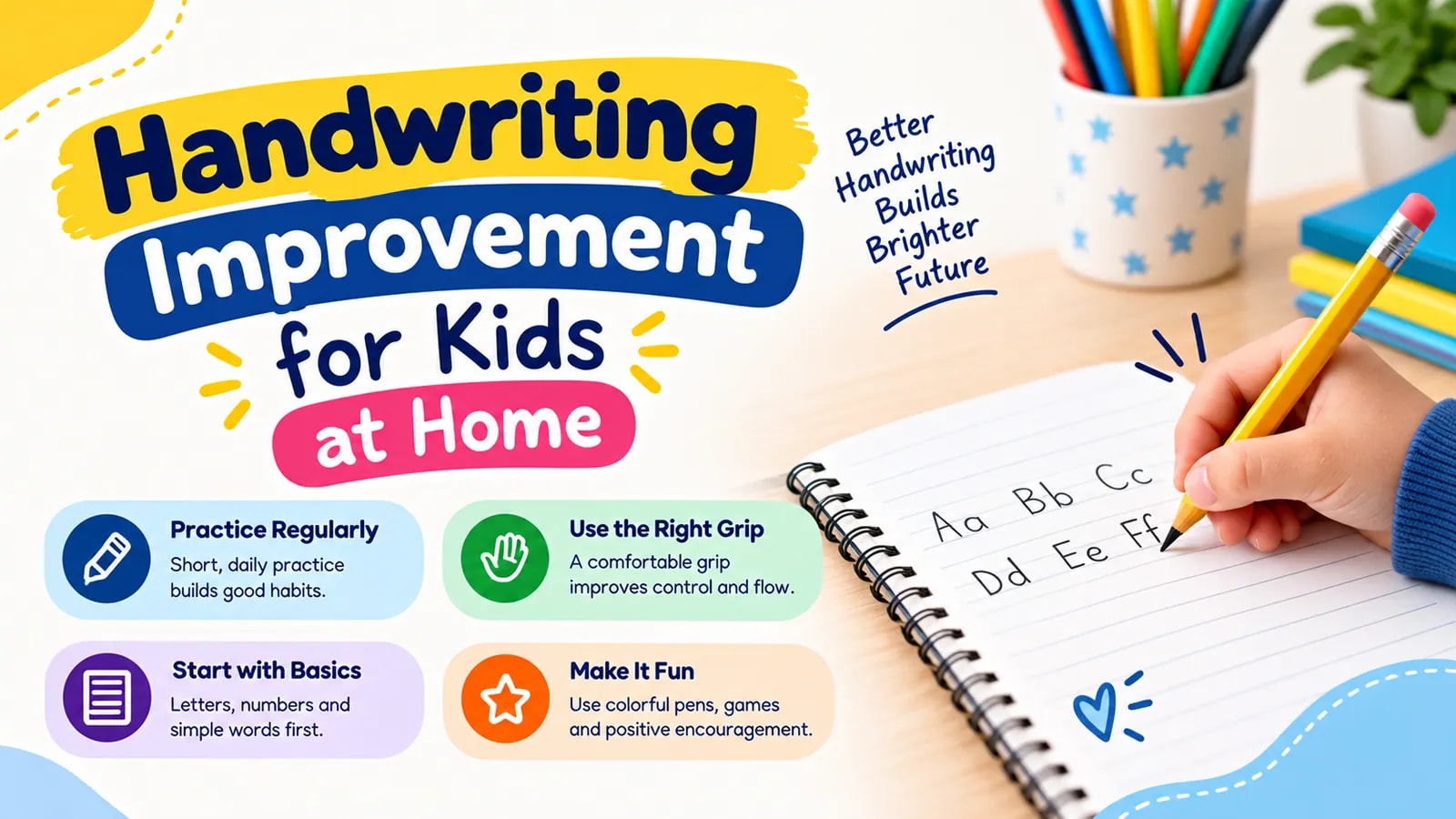
Your 4-Week Handwriting Plan at Home
Week Focus Daily 10-minute routine 1 Grip, posture, hand strength 3 min finger play + 5 min pre-writing lines and curves + 2 min relax 2 Letter formation Trace and write 3-4 letters correctly, always starting at the top 3 Size, spacing, line alignment Write short words on four-line or bold-line paper, using a finger or stick as a space marker 4 Sentences and confidence Copy 2-3 neat sentences, then write one on their own
By age:
Ages 3-5: Stay on pre-writing shapes, tracing, and fine motor play. Don't push full writing yet.
Ages 6-8: Focus on correct letter formation, uniform size, and spacing.
Ages 9+: Work on speed with legibility, connected writing, and posture.
Set Up the Right Writing Corner
Feet flat on the floor, back supported
Table at elbow height
Good light, with the paper slightly tilted toward the writing hand
A slanted writing surface (even a firm folder or a binder propped up) can help
Common Mistakes Parents Make
Correcting every letter in one sitting
Comparing with a sibling or classmate
Pushing long writing sessions
Skipping the fine motor and pre-writing stage
Treating handwriting as a punishment task
What Research Tells Us About Handwriting and Your Child
Most parents never hear these facts. Here is what studies have found.
1. Small-hand skills in kindergarten predict later school results. A well-known 2010 analysis of six long-term datasets found that attention, fine motor skills, and general knowledge together predicted later math, reading, and science scores much better than early math and reading scores alone. In simple terms, how well a young child controls their fingers is a useful early signal of how school will go.
2. Poor handwriting in Grade 1 can follow a child into later years. Researchers at the University of Washington reported that children with poor handwriting in first grade are likely to struggle with written expression when they are older. They found a direct carry-over from handwriting to the length and quality of writing throughout elementary school. When letter shapes become automatic, the child has more mental energy left for composing ideas.
3. Your child uses their hands for a large part of the school day. Classroom observation research found that students spent between 37.1% and 60.2% of the school day on fine motor activities, with handwriting alone accounting for 3.4% to 18%. Handwriting isn't a side skill. It runs through the whole school day.
4. Writing letters by hand builds reading-related brain pathways in young children. In a brain-imaging study of preschoolers, children who printed letters showed greater activity in a reading-related brain region when looking at letters than children who learned the letters without printing. Both groups learned to recognise the letters, but their brain response differed. This is one reason tracing and writing on paper still matter, even when tablets are easy to hand over.
5. Handwriting is a memory skill, not only a hand skill. The Washington researchers noted that handwriting is not just a motor process. It is also a memory process for letters, the building blocks of written language. In their program, the treatment also boosted reading skills, probably through better letter recognition.
6. Handwriting difficulties are common. Estimates cited in research suggest that poor handwriting or dysgraphia affects roughly 10 to 30% of school-aged children. If your child struggles, early support helps.
7. Handwriting vs typing: the newest brain research. A 2024 Norwegian study recorded the brain activity of 36 university students. It found that handwriting produced widespread connectivity across brain regions that was absent during typing. One caveat: the participants were adults, and later commentary noted the study did not test learning or memory directly. So it is interesting evidence, not proof about children.
These studies show links, not guarantees. Handwriting practice alone won't decide a child's results, but a strong foundation makes school easier and more enjoyable.
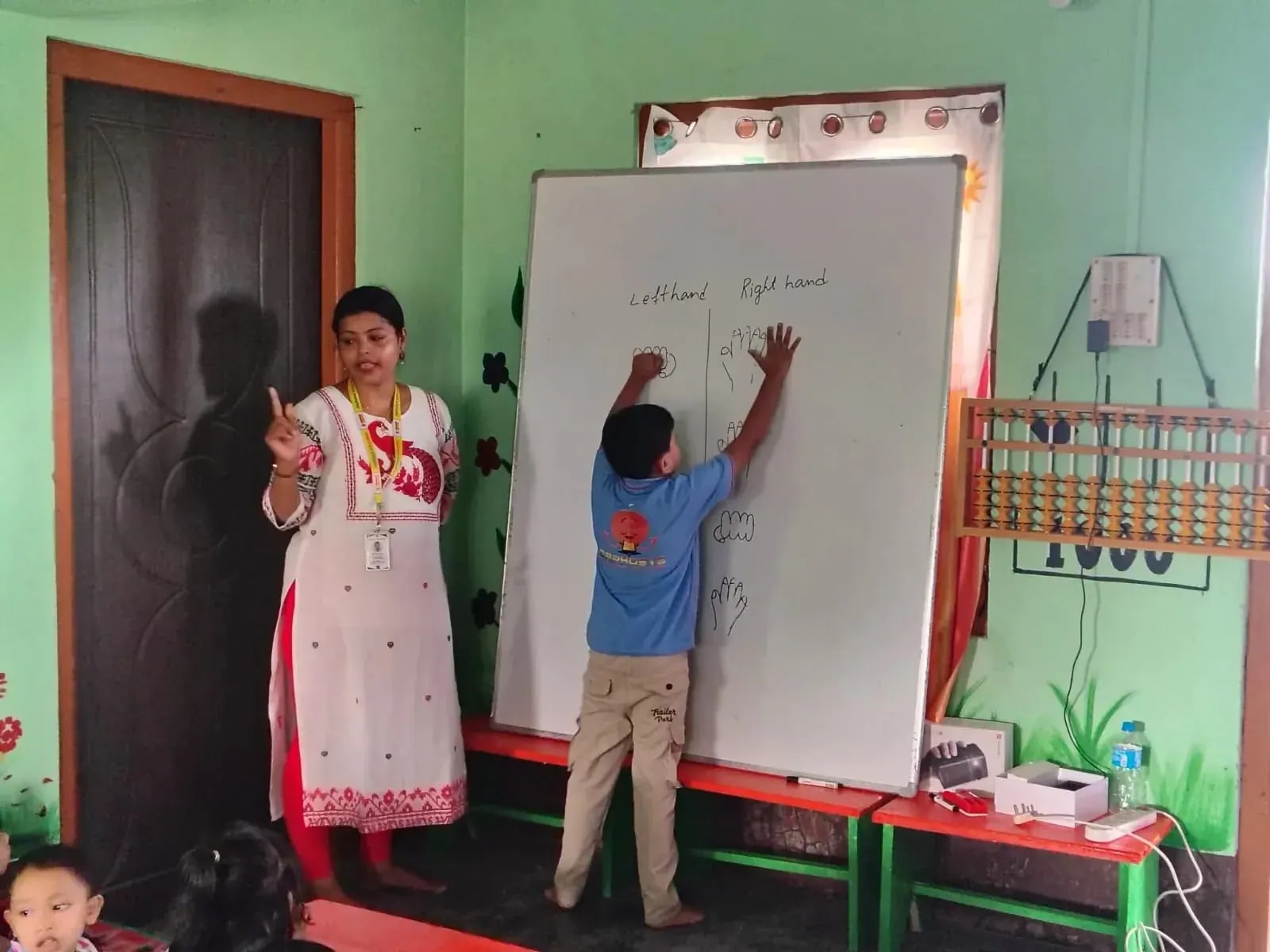
From our classroom: at Orphosys Foundation, our teacher guides children step by step, from finger play and pencil grip to neat letter writing. Every child learns at their own pace, with practice that feels like play
When Should You Look for Extra Help?
Home practice works for most children. Consider talking to a teacher or a child development professional if:
Your child still struggles badly after several weeks of steady practice
Writing causes real pain or strong frustration
There is a big gap between what your child says and what they can put on paper
Letters are consistently reversed or very hard to read at an older age
Early support makes a big difference.
Handwriting and the Growing Brain
Writing is a hand-and-brain skill. It brings together focus, memory, visual coordination, and fine motor control. That's why activities that train concentration and finger coordination, such as abacus learning, often go hand in hand with better writing habits. Children who enjoy building these skills usually become more confident learners across subjects.
At Orphosys Foundation, our programs are designed around child brain development, helping children build focus, coordination, and confidence step by step. If you'd like guidance for your child's age and needs, visit your nearest Orphosys center.
[Call +91 90462 40290] [Find a center near you]
FAQs
At what age should a child start improving handwriting? Pre-writing skills like lines, shapes, and hand-strength play can begin from around age 3. Formal letter writing comes later, when the child is ready.
Can bad handwriting be fixed at any age? Yes. It's easier when started early, but improvement is possible at any stage with consistent, patient practice.
How long does it take to see improvement? Many parents notice better grip and control within a few weeks of daily short practice. Lasting change takes longer.
Are handwriting worksheets enough? Worksheets help, but they work best alongside fine motor play, correct posture, and a good grip.
Should my child write in cursive or print? Follow your child's school. Consistency matters more than style.
References
Grissmer, D., Grimm, K. J., Aiyer, S. M., Murrah, W. M., & Steele, J. S. (2010). Fine motor skills and early comprehension of the world: Two new school readiness indicators. Developmental Psychology, 46(5), 1008-1017.
Berninger, V., & Abbott, R. University of Washington handwriting research (UW News release, 1998).
James, K. H., & Engelhardt, L. (2012). The effects of handwriting experience on functional brain development in pre-literate children. Trends in Neuroscience and Education.
Caramia, S., Gill, A., Ohl, A., & Schelly, D. (2020). Fine motor activities in elementary school children: A replication study. American Journal of Occupational Therapy, 74(2).
Van der Weel, F. R., & Van der Meer, A. L. H. (2024). Handwriting but not typewriting leads to widespread brain connectivity: A high-density EEG study with implications for the classroom. Frontiers in Psychology, 14:1219945. Commentary: Pinet, S., & Longcamp, M. (2025), Frontiers in Psychology.
McGlashan, H. L., et al. (2017). Improvement in children's fine motor skills following a computerized typing intervention. Human Movement Science.
Orphosys Team
Editorial team at Orphosys Foundation, dedicated to brain development and academic excellence.
Discussion (0)
Be the first to share an insight