
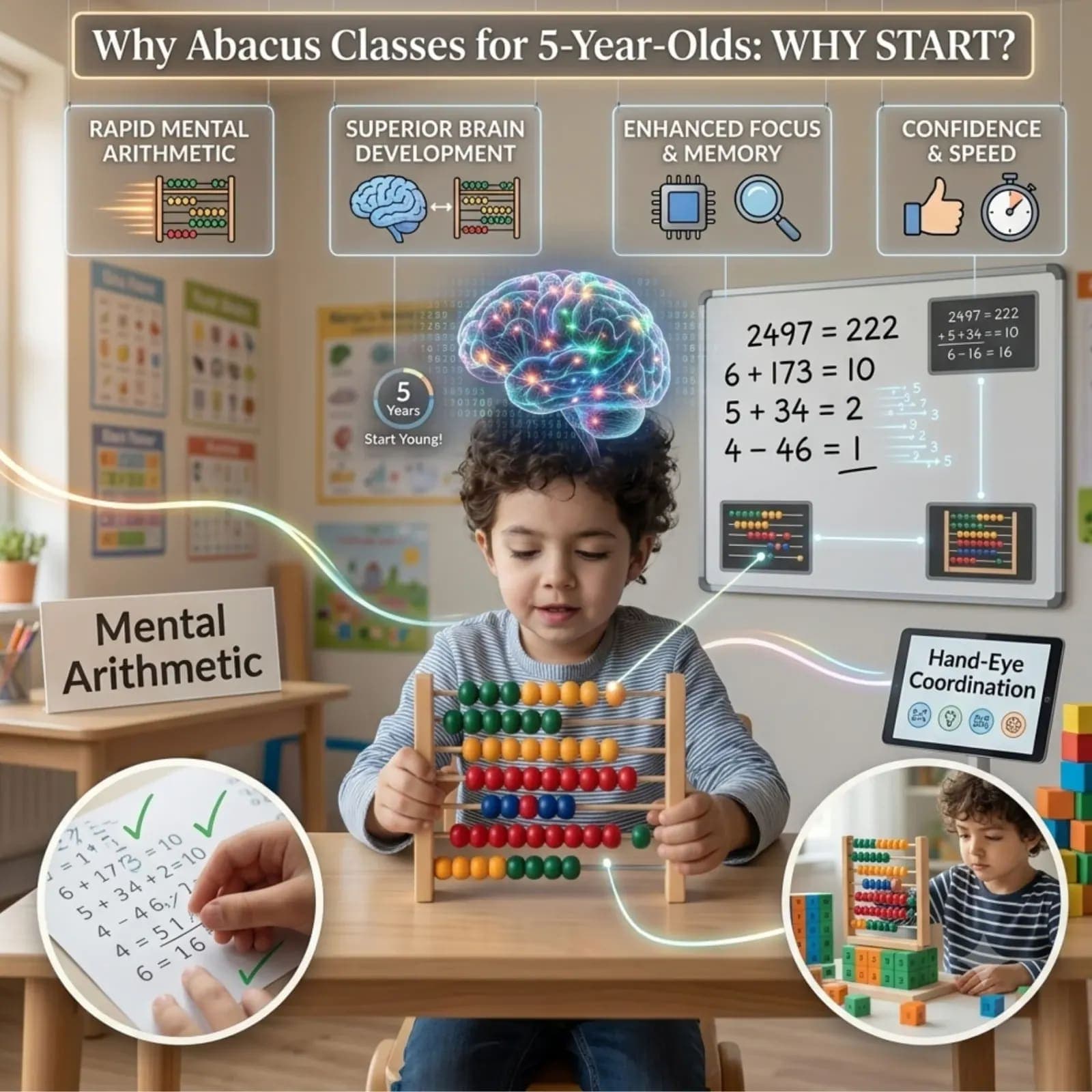
Abacus Classes for 5-Year-Olds: The Complete 2026 Parent's Guide
Five is one of the most talked-about ages in early math education — and for good reason. It's the age when most children can count with real understanding, sit through a short structured activity, and start forming lifelong learning habits. Naturally, it's also the age most parents start asking: "Is my child ready for abacus classes?"
This guide answers that question in full — with a quick history of the tool itself, age-readiness signs, what actually happens in a Level 1 abacus class, real (non-exaggerated) benefits backed by research, what to look for in a good program, and a straightforward cost comparison — so you can make a confident decision instead of a rushed one.
Table of Contents
What Is an Abacus? A Quick History
Is 5 the Right Age to Start Abacus?
How to Know If Your 5-Year-Old Is Ready
What Happens in an Abacus Class at This Age
Real Benefits of Abacus Learning for Young Children
The Science Behind Abacus Training
Online vs Offline Abacus Classes for a 5-Year-Old
How Abacus Levels Work (7-Level Structure Explained)
What to Look For in a Good Abacus Program
Common Myths Parents Should Ignore
Abacus Classes Cost in India (2026)
FAQs: Abacus Classes for 5-Year-Olds
1. What Is an Abacus? A Quick History
An abacus is a simple manual counting frame — rows of beads sliding along rods — that people have used to perform arithmetic for roughly 2,500 years, long before calculators or written numeral systems were widespread. Early merchants and traders relied on it to add, subtract, and keep records of goods, and engineers used it for measurement and construction calculations. Versions of the tool appeared independently across ancient Mesopotamia, Rome, China (the suanpan), and Japan (the soroban), which is the design most modern children's abacus programs are based on today.
What makes the abacus relevant thousands of years later isn't nostalgia — it's that the same bead-based, hands-on structure happens to be an unusually effective way for young children to see numbers rather than just recite them, which is exactly why it's taught as an early-childhood math tool today rather than a historical curiosity.
2. Is 5 the Right Age to Start Abacus Classes?
Yes — five is widely considered the earliest practical age to begin structured abacus training, and it's the age most certified abacus programs in India open enrollment at, typically running through age 10 or beyond. Educators generally recommend a window of 5 to 13 years, with 5–7 years called the "golden period" because children are highly receptive to visual and pattern-based learning at this stage.
That said, age alone isn't the whole story. What matters more than the number on the calendar is whether your child has hit two specific developmental markers — which we cover next.
Quick answer: If your child can count to 20+ with understanding (not just recite numbers) and sit through a 15–20 minute focused activity, they're ready to start.
3. How to Know If Your 5-Year-Old Is Ready for Abacus
Before enrolling, check for these five signs of readiness:
Number recognition: Can identify numbers up to at least 20–30 and understands that "3" means three actual objects (one-to-one correspondence).
Basic counting confidence: Counts objects rather than just reciting numbers in sequence.
Attention span: Can stay engaged in one seated activity — drawing, a puzzle, a story — for 15–20 minutes without constant redirection.
Fine motor control: Can pick up and place small objects (beads, blocks, crayons) with reasonable control, since abacus work involves precise finger movement on the beads.
Comfort with instructions: Can follow a two-step spoken instruction ("pick up the red bead, then move it up").
If most of these are still developing, that's completely normal — waiting six months to a year rarely causes any disadvantage, and starting when a child is genuinely ready produces far better results than starting early and forcing it.
4. What Happens in an Abacus Class for a 5-Year-Old
A well-designed Level 1 program for young beginners is playful and visual, not textbook-heavy. Typical building blocks include:
Getting familiar with the tool — learning the parts of the abacus (rods, beads, the bar) through drawing, coloring, and hands-on play before any calculation begins.
Number formation on the abacus — representing numbers 0–9 by moving beads, matched with fun worksheets like "match the following" and "tick the correct answer."
Simple addition and subtraction — introduced gradually using single digits, with "friends of 5" and "friends of 10" concepts (called compliments) taught through stories and games rather than drills.
Short, frequent sessions — 30–45 minutes, 1–2 times a week, since young children learn best in short, high-engagement bursts rather than long lectures.
Take-home practice sheets — five to ten minutes of daily practice at home to build muscle memory on the beads.
By the end of a solid beginner level, a 5-year-old can typically add and subtract small numbers using the physical abacus confidently and has begun the first steps toward doing simple sums mentally.
5. Real Benefits of Abacus Learning for Young Children
It's worth separating genuine, observed benefits from marketing exaggeration. Here's what abacus training reliably supports at this age:
Faster calculation speed
Regular bead practice builds a level of arithmetic fluency that's hard to reach through worksheets alone, since a child is physically representing each step of a calculation rather than memorizing a result.
Stronger number sense
Children build an intuitive, visual understanding of quantity rather than rote-memorizing facts — a foundation that makes later math (fractions, place value, mental math) easier to grasp.
Improved concentration
Because each bead movement requires attention, regular practice builds sustained focus — a skill that transfers to classroom listening and homework habits.
Fine motor and hand-eye coordination
Moving small beads accurately with the thumb and index finger strengthens the fine motor skills also used in handwriting.
Bilateral brain engagement
Abacus work is a two-handed activity — one hand anchors the frame while the other moves the beads — so both sides of the body, and by extension both hemispheres of the brain, stay engaged through every calculation.
Better memory and confidence
Success with a physical, tactile tool gives children an early "I can do math" identity and measurably sharper working memory for numbers, which matters more long-term than raw speed.
A note on realistic expectations: Abacus training does not "rewire the brain" or guarantee a higher IQ, despite what some marketing claims. What it reliably delivers is faster mental calculation, stronger number confidence, and better focus — genuine, useful outcomes on their own merit.
6. The Science Behind Abacus Training
Beyond classroom observation, abacus-based mental calculation (AMC) has actually been studied by neuroscience researchers looking at brain-imaging data from children who train long-term. In plain terms, here's what that research points to:
Better-connected memory circuits. Children with extended AMC practice tend to show a higher capacity for numerical memory, along with signs of more efficiently linked neural pathways compared to non-trained peers.
Stronger visual-processing regions. Brain-mapping studies have found trained children show more efficient activity in the visual-processing areas at the back of the brain — the regions responsible for interpreting spatial and visual information — which lines up with the abacus method's heavy reliance on mentally "picturing" the beads.
A link to math performance. One visual-processing region in particular (the fusiform gyrus) showed a notable connection to stronger overall math ability in trained children, suggesting the visualization skill abacus builds carries over directly into general numeracy.
Faster reaction times. Across multiple comparisons, children with abacus training scored better and reacted faster on calculation tasks than children without training.
Auditory benefits, too. Interestingly, long-term training has also been associated with improvements in auditory processing skills, not just visual-spatial ones.
The takeaway for parents: the "mental math" abacus is famous for isn't a party trick — it's the visible result of children training their brains to picture and manipulate numbers spatially, which is measurably different (and additive) compared to standard rote-memorization math instruction.
7. Online vs Offline Abacus Classes for a 5-Year-Old
Factor Online Classes Offline (In-Center) Classes Convenience Learn from home, no commute — ideal for busy schedules or smaller towns/cities Requires travel time; fixed physical schedule Parent supervision Parents can sit in and monitor engagement directly Parents get less visibility into the actual class Peer interaction Limited to small live batches over video More natural peer interaction and hands-on group energy Consistency Same certified instructor across time zones/batches Depends on local center staffing Best for Working parents, non-metro cities, kids who focus well on screens for short bursts Kids who need in-person energy and social learning
For a 5-year-old specifically, look for small live batches (ideally under 8–10 students) regardless of format — young children need individual attention and correction on bead technique that's hard to give in large groups.
8. How Abacus Levels Work (The 7-Level Structure)
Most reputable abacus programs follow a structured, roughly 7-level curriculum that a 5-year-old progresses through over several years:
Level 1 — Tool familiarization, number formation, single-digit addition/subtraction
Level 2 — Compliments of 5 and 10, double-digit operations
Level 3 — Multi-row addition/subtraction, introduction to multiplication
Level 4 — Multiplication (1D–3D), early division
Level 5 — Multi-digit division, decimals
Level 6 — Advanced multiplication/division, percentages
Level 7 — GCD, LCM, square roots, cube roots, and full mental (no-abacus) calculation
Each level typically takes 8–12 weeks, meaning a child who starts at 5 can realistically complete the full program by age 10–12 — which is why most programs cap enrollment at "5 to 15 years" rather than opening it to teenagers, who tend to lose interest once they've already covered equivalent arithmetic in school.
9. What to Look For in a Good Abacus Program
Not all abacus courses are equal. Before enrolling your 5-year-old, check for:
Certified instructors experienced specifically with 5–7 year age groups, not just abacus knowledge in general
Small batch sizes for individual bead-technique correction
A physical abacus kit included with the course (not just digital worksheets)
Structured levels with clear progression and periodic assessment
Trial class availability so you can gauge your child's actual engagement before committing
Reasonable session length (30–45 minutes) — anything longer risks fatigue at this age
Transparent pricing with no hidden costs for kits, certificates, or materials
10. Common Myths About Abacus Learning — Debunked
"Abacus makes kids math geniuses overnight." No — it builds strong fundamentals gradually, like any skill, over consistent practice across levels.
"Younger is always better." Not true — starting before a child has basic number sense often leads to frustration rather than progress. Readiness matters more than age.
"It replaces school math." It complements school curriculum by strengthening number sense and calculation speed; it isn't a substitute for classroom learning.
"Only in-person classes work." Well-run live online classes with small batches can be just as effective, especially with active parent involvement at this age.
11. Abacus Classes Cost in India (2026)
Pricing for certified abacus programs for 5-year-olds in India generally falls in these ranges:
Online live group classes: ₹4,000–₹9,000 for a 3-month/one-level package, usually inclusive of an abacus kit and worksheets
Offline center classes: ₹1,500–₹4,000 per month, often with additional one-time kit/registration charges
Private/1-on-1 online tutoring: ₹6,000–₹15,000+ per month depending on instructor experience
Tip: Always ask whether the abacus kit, workbook, and certificate are included in the quoted price — some programs advertise a low headline fee and add these as extras later.
12. FAQs: Abacus Classes for 5-Year-Olds
Q1. Is 5 too young to start abacus classes? No. Five is generally considered the earliest suitable age, provided your child can count with understanding and focus for 15–20 minutes. If not quite there yet, waiting a few months is perfectly fine.
Q2. How many days a week should a 5-year-old attend abacus class? Most programs recommend 1–2 live sessions per week (30–45 minutes each), supplemented by 5–10 minutes of daily practice at home. Abacus Classes for 5 Year Olds Child
Q3. Do abacus classes really improve concentration and memory? Yes, to a meaningful degree — regular bead-work practice has been associated with improved concentration, reaction time, and visual memory in children, though results build gradually with consistent practice rather than instantly.
Q4. Should I choose online or offline abacus classes for my 5-year-old? Either works well if the batch size is small and the instructor is experienced with young children. Online suits convenience and parental supervision; offline suits kids who thrive on in-person group energy.
Q5. How long does it take to complete the full abacus program? A child starting at age 5 typically completes all 7 levels by around age 10–12, progressing through one level roughly every 8–12 weeks with consistent attendance.
Q6. What should I buy for my child to start — do they need their own abacus? Yes, a personal abacus tool is essential from day one; most reputable programs include one in the enrollment kit along with a practice workbook.
Q7. How old is the abacus as a tool, and is it still relevant today? The abacus dates back around 2,500 years, originally used by traders and engineers. It remains relevant today not for calculation in daily life, but because its hands-on, visual structure is unusually effective for teaching young children number sense.
Key Takeaway
Five is a genuinely good age to start abacus classes — not because earlier is automatically better, but because it's typically when children have the number sense, attention span, and fine motor control the method needs to actually work. Focus less on chasing the "perfect" starting age and more on choosing a program with small batches, certified instructors, and a structured level system your child can grow through for years to come.
Learn More About Meta Skill Based Abacus
If you'd like to see how Meta Skill Based Abacus works in practice, Orphosys Foundation runs this program across centers in Kolkata, Ranchi (Jharkhand), Bhubaneswar (Odisha), Assam, and Tripura.
Get in touch: 📞 +91 90462 40290 🌐 orphosysfoundation.org
Related reading: Abacus Classes for Kids: Benefits, Age to Start & What to Expect | Abacus Classes Near Me: Why Orphosys Foundation Is the Right Choice
Orphosys Team
Editorial team at Orphosys Foundation, dedicated to brain development and academic excellence.
Discussion (0)
Be the first to share an insight