
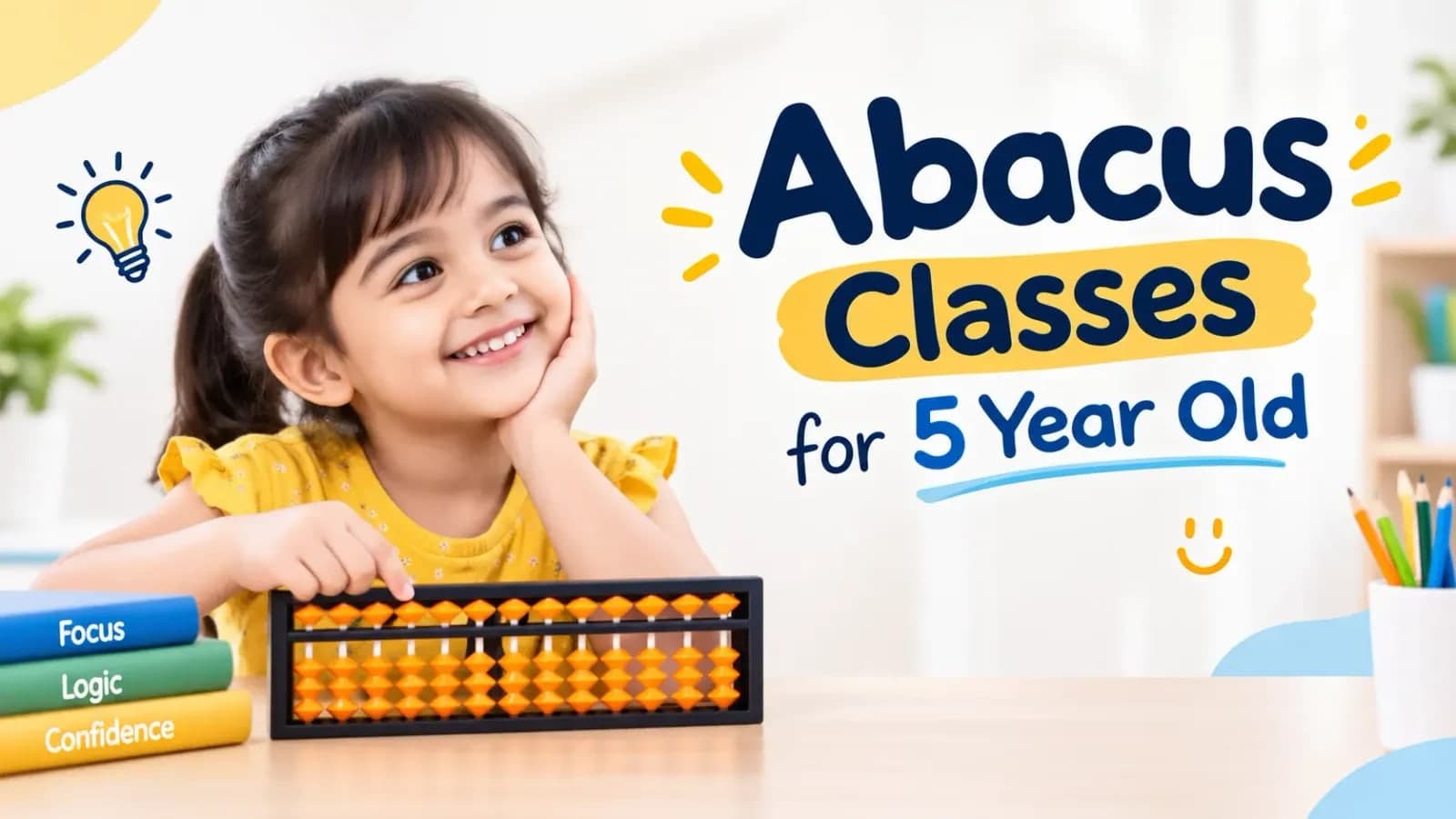
Abacus Classes for 5 Year Old: Is Your Child Ready to Begin?
If you've been searching for abacus classes for a 5 year old, you've probably already noticed something: almost every abacus center will tell you five is a good age to start. What most of them don't tell you is why five works, what actually happens in a real class, and how to tell if your specific child is ready — or if waiting a few months would serve them better.
At Orphosys Foundation, we've been running abacus and brain-development programs for children since 2012, and five-year-olds make up one of the largest groups walking through our doors every year. This guide breaks down what abacus classes for 5 year olds actually look like, what to expect in the first few weeks, and how to choose a program that won't waste your child's time — or yours.
Is 5 the Right Age to Start Abacus?
This is the single most common question we get from parents, and it's also the subject of a lot of conflicting advice online. Here's the honest answer.
Five is generally considered the ideal starting age for abacus, but age alone isn't the full picture. What actually matters is whether a child has reached two developmental markers:
They can recognize numbers at least up to 20–50, and ideally count objects rather than just recite numbers by rote
They can sit and stay engaged with a single activity for roughly 15–20 minutes without needing constant redirection
Most children hit both of these markers somewhere between age 5 and 6. That's not a coincidence — it's exactly the window where fine motor control (needed to move abacus beads accurately) and basic number sense come together. Start meaningfully earlier than this, and a child is often just moving beads without connecting them to quantity. Start much later, and it simply takes longer to build the instinctive, calculator-fast mental arithmetic that abacus training is known for.
So if someone asks "what is the best age to start abacus," the honest answer is: five to six years old for most children, with the child's own readiness mattering more than the calendar.
What Happens in a Real Abacus Class for a 5 Year Old
A lot of parents imagine abacus class as a child sitting quietly doing sums with beads. In practice, a well-run class for this age group looks nothing like that, and it shouldn't.
For a five-year-old, the first several weeks are almost entirely about comfort and coordination, not calculation:
Getting familiar with the physical abacus — how beads move, what each row represents
Simple bead movement games that build fine motor control and hand-eye coordination
Number recognition and counting reinforcement, folded into play rather than drilled
Very short concentration exercises, gradually extended as the child's attention span grows
Actual calculation — even simple single-digit addition — typically comes a few weeks in, once the child is physically comfortable with the tool. Any program that pushes a five-year-old straight into multi-digit sums in week one is moving faster than the child's development can support, and it usually backfires: the child gets frustrated, and parents mistake that frustration for "my child isn't good at this," when really the pacing was wrong.
What Parents Should Actually Watch For in the First Few Sessions
Rather than judging progress by how fast a child can add numbers, watch these three things in the first month:
Does the child return to class willingly? A five-year-old who dreads going back is a much bigger red flag than one who's slow with beads.
Is fine motor control improving? You should see beads moved more precisely and confidently week over week — that's the real early win, not speed.
Can they sit through the full session? Attention span growth is often the first visible result of abacus training for this age group, showing up before any calculation skill does.
If none of these are improving after a month or two, it's worth having a direct conversation with the instructor about pacing — not necessarily pulling the child out.
Mental Maths for 5 Year Olds: What's Realistic?
Parents often ask when their child will be doing "mental maths" — solving problems without looking at the abacus at all. For most five-year-olds, this is a longer runway than marketing materials suggest.
Mental maths for 5 year olds develops in stages:
First, comfort with the physical abacus and basic bead movements
Then, simple addition and subtraction while still using the physical tool
Only later — often after 6 to 12 months of consistent practice — does a child begin visualizing the abacus mentally and calculating without it
This is normal, not slow. Mental calculation is the advanced stage of abacus learning, and rushing toward it too early undermines the visualization skill it depends on. A five-year-old who's building a solid physical foundation for six months is on a completely healthy timeline, even if they're not yet doing sums "in their head." read more
What to Look for in Abacus Classes for Beginners
If you're comparing abacus classes for beginners — especially for a child this young — a few things matter more than others:
Age-appropriate pacing. Ask specifically what a five-year-old does in the first month. If the answer is generic or jumps straight to calculation, that's worth questioning.
Class size. Young children need individual correction on bead technique; large classes make that difficult.
Instructor experience with this specific age group. Teaching abacus to a 5-year-old is a different skill from teaching a 9-year-old — the instructor should be able to speak to that difference directly.
A trial or observation class. Any program confident in its methodology should let you sit in or trial a session before enrolling.
At Orphosys Foundation, our abacus program spans ages 4 to 15, but we structure it in age-specific stages rather than running one curriculum for everyone — which is exactly why pacing questions like these matter so much when you're evaluating a class for a five-year-old specifically.
Abacus Classes for 5 Year Old Child: A Realistic First-Year Timeline
To set expectations clearly, here's roughly what a consistent first year looks like for a five-year-old starting from zero:
Weeks 1–4: Comfort with the physical abacus, bead movement games, number recognition reinforcement
Weeks 5–12: Basic single-digit addition and subtraction using the physical abacus
Months 4–8: More complex calculations, growing confidence, longer concentration spans
Months 8–12: Early visualization exercises — the beginning of mental maths, done gradually and without pressure
Every child moves through these stages at their own pace, and that's expected. The timeline is a guide for what "normal progress" looks like, not a race.
At last Abacus Classes for 5 Year Old: Is Your Child Ready to Begin?
Abacus classes for a 5 year old can be genuinely valuable — but only when the program respects where a five-year-old actually is developmentally, rather than treating them like a smaller version of an eight-year-old. Look past the "best age to start abacus" claims and pay attention to what actually happens in the first month of class. That's where you'll find out whether a program is right for your child.
If you're in Kolkata and want to see what an age-appropriate abacus class for a five-year-old looks like in person, you're welcome to visit Orphosys Foundation for a trial session and judge the pacing for yourself. Read more abut Finding the Best Abacus Center Near Me: Unlocking Your Child's Brain Potential
Orphosys Team
Editorial team at Orphosys Foundation, dedicated to brain development and academic excellence.
Discussion (0)
Be the first to share an insight